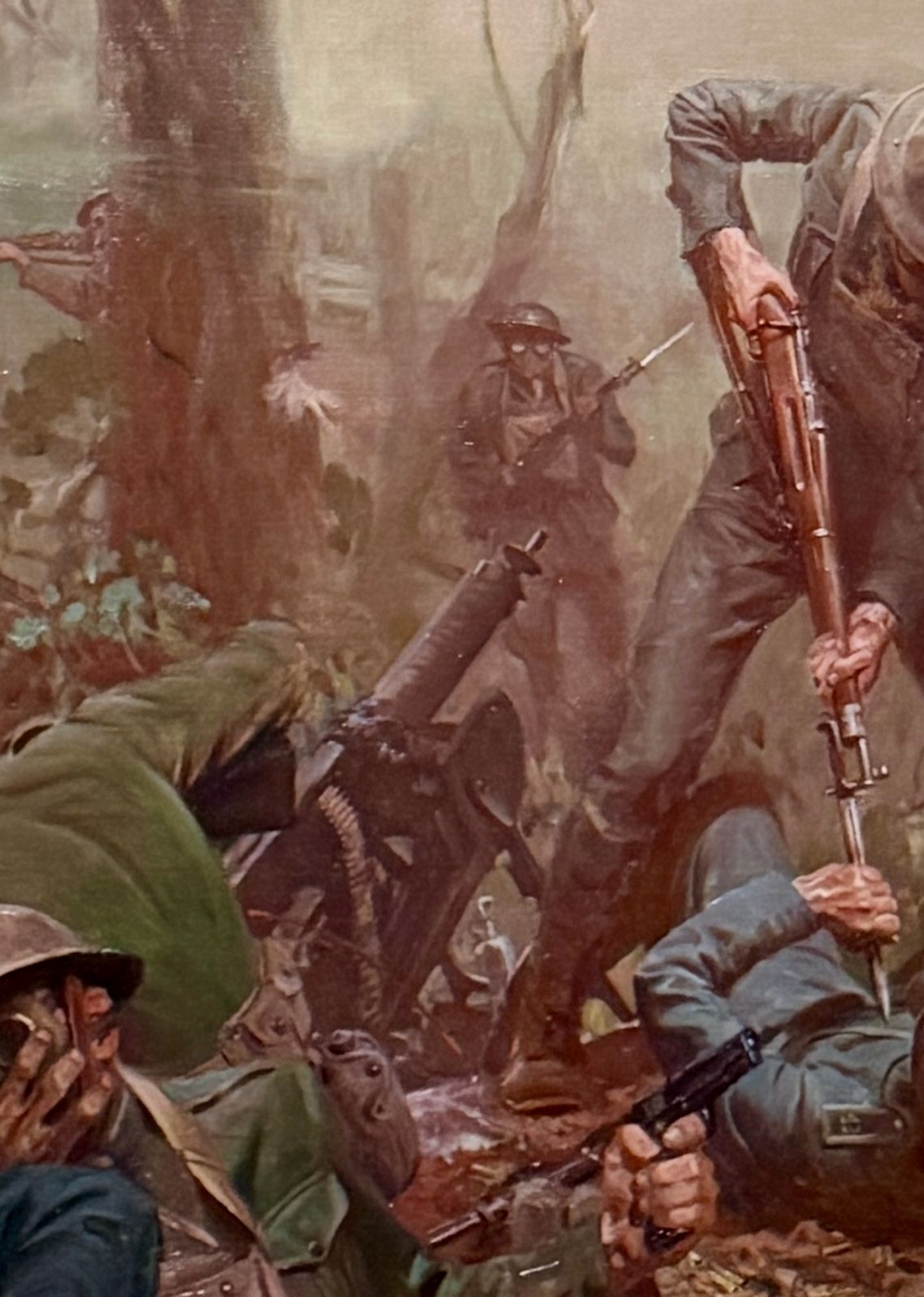

The Jack


The Jack - Often referred to simply as “The Jack,” the iconic image of a Marine driving his bayonet into a German soldier at Belleau Wood has become one of the most recognizable pieces of Marine Corps combat art.The painting, commonly titled “Belleau Wood” or “Into the Breach at Belleau Wood,” was created around 1944 by Sergeant Tom Lovell, a combat artist serving with the U.S. Marine Corps Reserve. Lovell was an accomplished illustrator who worked for Leatherneck Magazine while stationed at Quantico, documenting Marine Corps history through dramatic battlefield imagery.The artwork depicts the savage close-quarters fighting that defined the Battle of Belleau Wood in June 1918. Marines advancing through the shattered forest often fought at distances measured in yards, sometimes only feet. Rifle fire quickly gave way to grenades, bayonets, pistols, and hand-to-hand combat.Because of its intense depiction of bayonet combat, the painting has become a classic example of what Marines often jokingly call “Stabby Art.” This informal term refers to war illustrations that capture the brutal reality of close combat where the bayonet, rather than the rifle, becomes the decisive weapon.At first glance, many viewers interpret the image as a Marine bayoneting a defenseless German soldier lying on his back. That interpretation misses an important detail in the composition. If you look closely into the left background of the painting, you can see the silhouette of a German Maxim machine gun.That machine gun was likely the weapon the German soldier had been operating moments earlier.During the battle, Maxim machine guns were among the most devastating weapons on the battlefield. Positioned along the tree lines and strongpoints inside the forest, they cut down advancing Marines by the dozens. Entire waves of attackers could be halted or destroyed by a single well-placed gun.Seen in that context, the image captures something far closer to the reality of Belleau Wood. The Marine is not attacking a helpless opponent. He is closing with and destroying the enemy who had just inflicted catastrophic losses on his fellow Marines.The Marine figure in the painting has come to be known informally as “The Jack,” a symbol used by many Marine units to represent ferocity in combat. The image embodies the relentless aggression that Marines brought to the battlefield in 1918 as they fought through wheat fields, shattered forests, and fortified machine gun positions.More than a dramatic illustration, the painting represents a defining moment in Marine Corps history. At Belleau Wood the Marines proved themselves in some of the fiercest fighting of the First World War.The image captures that reputation in a single moment of violent clarity.It symbolizes the Marine Corps ethos of closing with and destroying the enemy and accomplishing the mission completely and without hesitation